

It is
hard for me to take any one aspect of this magnificent country and
write about it in one post. This huge, sweeping land, that has seen
more than it's share of tragedy and bloodshed, much of it
self-inflicted, is a testament to patience and hardiness; the people
themselves, a blend of Mongol, Cossack, White Russian, Rus and little
blobs of colonies that settled over the centuries, containing
surprising mixes of Circassian near the Black Sea, and Yakuts in the
north, are the true gold and wonder of this land. A land I have been
passionately in love with since I was a kid and I asked my father why
Communism was bad and for once, he had no answer.
His
concession meant much to me later on; there really was no clear answer that he
could give me in words I would understand at the time, as I was a
child. It would be up to me to find out. I figured I already had a
start because I was busy plowing through Tchaikovsky's ouvre of
lighter works; “1812 Overture”, “Marche Slave”, and the
“Nutcracker”; listening to them on first, a turn-table, then a Magnavox Stereo, wired-up by my father, so that the house shook with the sound of cannon-fire in the Overture's Finale. But all I was really exposing myself to at the
time, was a Russian composer's depictions of Napoleon's ill-fated
march on Moscow, the Crimean War, in which “Crimea Doesn't Pay”
(a horrible, horrible Mr. Peabody and Sherman joke from 1961) and a
much-loved ballet that was probably highly influenced by the French,
who at the time, were pretty firmly entrenched within the Russian
Court. So entrenched, in fact, that at one time, the Russian nobles
didn't speak Russian, they communicated in French.

Some of my Russian History classes in college required French as a pre-requisite because for centuries, the Russian aristocracy didn't speak, read or write any Russian. For someone who is not a natural polyglot, it was a bit of an overload. My Spanish is worse than my Russian; my French is non-existent, yet I took Spanish for seven years and Russian for two. I skipped French altogether and relied on cognates. Go figure.
This may
be partly due to the fact that during the reign of Peter the Great,
he took the Busman's tour and spent approximately eighteen months in
western Europe, incognito and learned how to build ships, learned
about architecture and science and as much as he could about the art
of warfare. He returned home precipitously as there was an uprising
amongst the boyars (barons) called the Bulavin
Rebellion. By the time he returned home, the rebellion had been
crushed. Peter was determined to drag Russia kicking and screaming,
if need be, into the 18th century; he made the boyars
assume western dress, rather than wearing the loose, oriental-style
robes they had worn previously, and Peter ordered them to shave their
much-loved beards. If they chose not to do so, they were required to
pay an annual beard tax of 100 rubles.
Autocratic,
and often brutal, Peter is responsible for much of the modernization
that occurred in Russia during that period. Once he had built a navy,
he began a campaign of conquest, primarily in his search for
warm-water ports, ever important, in a country striving to become an
economic trading-partner and an even larger goal in the Russians'
eyes; prove themselves equal, if not greater on the world's stage.
After a little tiff with the Ottoman Empire, Peter made a temporary
peace with the Ottomans, which allowed him to keep the fort at Azov
and turn his attentions to building an even more formidable navy and,
oh, yeah, this in turn allowed him to look to the north and Sweden,
ruled by Charles XII.

Charles XII. Actually, his nose looked like it partook of the "Battle of the Cannons" with Peter and August II.
I should
mention here that Sweden was once feared, and had its own Empire and
a formidable army and Charles was no slouch when it came to being a
Military strategist. Peter coveted control of the Baltic Sea, which
had been taken from the Russians by the Swedes 50 or so years
earlier. One thing about the Russians that is a constant: if they
have owned or lived on, a piece of land and lost it, no matter how
distantly in the past, they will move heaven and earth to reclaim it and protect it. Remember KAL flight 007, shot down September 1, 1983, over Russian Territory, called Sakhalin Island? I do, and while the rest of the world wrung its hands, I understood it perfectly in the context of Russia's history; during the 20th Century, they were invaded in 5 separate wars, 3 of which most Americans know nothing about, because most Americans are ignorant of world history and how it affects current Global Hegemony.
This is a given. The other given is that they are oriental, or Asiatic in their patience, much like the Scots (I. e. my father got his ass put in a jail cell in Heathrow, in 1985, for 48 hours for bitching about how the English stole Scotland. The Customs took one look at his passport, saw his surname and in the hoosegow he went. The incident he was referring to occurred in 1297 A. D. – ya gettin' all this, Lithia?), and they will wait, and wait, and wait, but by God, they will take back what was taken from them. But, again, I digress.
This is a given. The other given is that they are oriental, or Asiatic in their patience, much like the Scots (I. e. my father got his ass put in a jail cell in Heathrow, in 1985, for 48 hours for bitching about how the English stole Scotland. The Customs took one look at his passport, saw his surname and in the hoosegow he went. The incident he was referring to occurred in 1297 A. D. – ya gettin' all this, Lithia?), and they will wait, and wait, and wait, but by God, they will take back what was taken from them. But, again, I digress.

One thing that all cold-weather countries have in common; they love to drink and drink to excess. Being a Scot, I can totally relate; it was said that Boris Yeltsin had to have his blood completely replaced from time to time, he was so pickled. I can believe that. The Russian word for "vodka" is very close and kin to the word for "water". It is literally, life, and comes in so many different varieties and flavors it boggles the mind and pallet!
 |
| Peter The Great |
Peter
lost his first battle against Charles, but Charles went from there
and stepped right into a big pile of Polish-Lithuanian Commonweatlh,
which gave Peter time to re-organize his army. As a side note, it
should be mentioned that Peter met with the Polish King Augustus II
the Strong, where the two rulers, after several days of boozing it
up, arranged a cannon-shooting competition. Augustus II the Strong
won, which by that time, I imagine, he could have been called
Augustus II the Deaf. Just kidding.Peter
took advantage of the lull in battle, and as the Swedes and the Poles
duked it out, he built a city. He founded the city of Saint
Petersburg, in a province of the Swedish empire, which he had
retaken, but that had originally belonged to the Russians. In typical
Peter logic and behavior, he forbade the building of all statues
outside of the city, so that he could hog all the stonemasons in
Russia. It should be noted that when he returned from his “Grand
Embassy” tour, he brought quite a contingent of brain-power and
skilled artisans with him. If he couldn't coax, he would buy. He had
a United Nations batch of shipwrights, naturalists, architects and
scientists.
Saint Petersburg was built on a swamp and it was built with every possible
resource and bit of manpower diverted from all parts of the country
to that cause. It was to become a showcase city and in concession to
the swamp, is a city of canals. Like Edinburgh, Scotland, it is
called the “Venice of the North”. Saint Petersburg is also the
city of “white nights”; being so far north, the sun does not set,
but sits low in the sky. It is a city of magic and beauty.

The Mariinsky Theatre which houses both the Ballet and Opera; with the typical Russian confusion and re-naming of things, the Kirov Ballet is now the Mariinsky Ballet, yet is still referred to as Kirov, yet is housed in the Mariinsky Theatre. Got that?
The city
is home to the Kirov ballet, not the Saint Petersburg ballet and
there is a terrible and sad reason for this. Post-Lenin, after 1929
and into the 30s, Sergei Kirov, who was the Commissar, of Governor of
Leningrad, (the former Saint Petersburg) had been a rising star in
the Politburo and up until a party split over the more draconian
implementations of party laws, when Kirov sided with the
“Trotskyites” (in Stalin's view and in hindsight, anyone who
wasn't four-square with him), Kirov was a devoted Stalinist. The
split saw the majority of the Politburo siding with Kirov, who urged
Stalin to basically cool his jets with the proletariat and lay off
the executions and sending people off to Siberia.
In the
spring of 1934, in a conciliatory and a mitigating move to the
people, Kirov argued that a majority of people should be released
from the prisons to work the collective farms and push forward
industrialization; a realization of Lenin's dream. Once again, Stalin
found himself a minority in the Politburo and after years of scheming
and rearranging positions to put himself in a position of assuming
total power and realizing that he could not count on rubber-stamp
support from the people he had placed in strategic positions, he, in
what would become recognizable as the beginnings of his
paranoid-purge style of ruling, began to wonder if Kirov, a much
younger man, was willing to wait for his mentor to die before
assuming total power of the Bolshevik Party.
During
their annual summer vacation on the Black Sea at the Dachas, Stalin,
who treated Kirov like a son, tried to persuade the younger man to
leave Leningrad and come back to Moscow and sit on the Politburo with
him, rather than remain the Commissar of Leningrad. Kirov refused and
Stalin believed that he had lost the support and loyalty of his young
protegé.
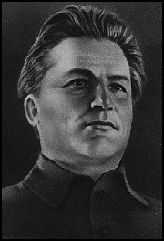
Kirov was viewed as a moderate and was a stalwart supporter of his people in his district. This had more to do with his refusal of Stalin's offer of a higher position within the party if he returned to Moscow, than any thoughts of betrayal of Stalin. His death changed the course of Russian history and Communism and certainly hastened the deaths of others within the inner party circle. Stalin's three-decade rule put the imprimatur on an economic and political system that was entirely different than what Lenin and Trotsky had in mind.
On
December 1, 1934, Kirov was assassinated by a young party member.
Many within the Politburo noted of the “hundreds of party members
rounded up and summarily shot in Leningrad, while others were dragged
from prison cells and executed.” The usual suspects were rounded
up, meaning most of the other party members, particularly the inner
circle, who had looked askance and verbalized there views to Stalin
(something encouraged under Lenin, but not so much after his death)
and they were interrogated.
Communist
party members abroad weighed in on the brew-ha-ha and confusion
reigned, until they finally managed to implicate practically the
entire Politburo, including Trotsky, who was already in exile and had
been expelled from the Communist party. He was safely ensconced in
Norway, at the invitation of Trgyve Lie and had actually helped Kirov
during the Civil War; Kirov was taught on the job, soundly beating
General Antonin Deninkin of the White Army. Trotsky's Red Army became
a superb fighting machine; an example of turning the pen into a sword
and using it with skill, but it had to be done by putting on blinkers
and elbowing other ambitious, yet ignorant party members to the side.
Trotsky was not popular with others, but he was true to Lenin's
original vision of what the USSR should be. As time went on, and
Stalin gathered more and more power, the inner circle began to see
the error of what they had, in fact, been warned about. But it was
too late.
Of
course, Stalin was a pallbearer at Kirov's funeral and there were
several monuments, cities, towns and burgs named after him, most of
which reverted back to their original names after the collapse of the
Soviet Union in 1991. But the most enduring and the loveliest of
these remains, and it is one of the Russian traditions of high art:
The Kirov Ballet. Located in Saint Petersburg (now, also renamed back
from “Leningrad” although, when I was studying Russian history
and this time period, World War II, it will always be “Leningrad”
just as “Stalingrad” will always be Stalingrad, as it evinces a
whole different set of pictures, for me than “Volgograd”) along
with The Bolshoi Ballet, perhaps the oldest in them all and the crown jewel of ballets,
this one city houses two of the finest ballet companies in the world.
It was
far easier for Stalin to cover up the assassination of Kirov, with
the “uncovering” of plots and then haul in his enemies, real and
imagined, a tactic he employed for decades. He went from the party to
the Red Army, shortly before World War II and that is one of the main
reasons the early days of the war for Russia against the Nazis was so
disastrous; the High Command and most of the Red Army Officers,
Strategists and Field Officers were dead. People like Nikita Kruschev
and Vasily Chuikov and his brothers emerged from the rank-and-file to
become part of the new Red Army that would save Mother Russia.
 | |
| Ио́сиф Виссарио́нович Ста́лин Iosif Vissarionovich Djugashvili |
 |
| Adolf Hitler |
Kruschev
is remembered for his shoe-banging during the 902nd plenary meeting of the UN General Assembly; this may have been in an attempt to liven things up. I can't imagine 902 meetings of anything that would be interesting. He's also remembered for his famous statement “We will bury
you [America] upon the ash heap of History!” and for the Ten Days
of October, when Kennedy went eyeball-to-eyeball with him, and
Kruschev stood down. But within Russia herself, Kruschev was a
reformer. He allowed the 1st publication of “A Day in the Life of Ivan Denisovich” a short novel, by AlexanderSolzhenitsyn. It quickly spread to the west and it was eagerly read
by one and all. There were at least two copies of it in my house as I
was growing up. I found a 3rd recently, as I was going
through some old stuff I thought I'd lost, when I lost my 2nd
house.
The book
is a marvelous little gem that describes Ivan's (pronounced Ĭ·văhn,
with the stress on the 2nd syllable) day; as he gets up,
eats, does his chores, negotiates with the “guards” for extra
goodies, talks to the other prisoners and finally goes to bed at
night. An instant hit in the USSR, it has remained timeless and is a
wonderful expression of one man's hope and ability to hang on and
appreciate what he has around him.
Kruschev's
little spring didn't last however, and he was more or less deposed.
He was pensioned off to his dacha on the Black Sea (Sochi sits on the western coast of the Black Sea, and at the foot of the Caucasus Mountains) and a little
apartment in Moscow. He was seen as too liberal; we used to play a
game when they had their May Day Celebrations and everyone marched
through Red Square in front of the Premiere and the other members of
the Politburo. It was like reading tea leaves. Who was in favor and
who was out of favor? Who stood closest to the Big Cheese and who had
disappeared altogether? In those days it was a difficult game to
play, since we had so few glimpses behind the Iron Curtain, and when
we did, we weren't always given a play list to follow along at home.

This is Novedevichy Cemetery and is far more interesting than the tombs and columbarium in Krasnya Ploshad (Red Square) Both Kruschev and Kirov are buried here, along with many other heroes of the Great Patriotic War. It is also a "mom and pop" cemetery and it is not unusual for folks to come and sit with their ancestors. This is a headstone for a Major General. The tank is a T-34. They held 4 men and were the terror of the Wehrmacht up and down the 1,000 mile-front line, but they were especially effective at the Battle of Kursk, where the little, agile tanks caught German General Guderian's juggernaut and the tide turned, in 1943. Later, it was said, the "German Wehrmacht stuck its tongue in a meat grinder." The southern salient was broken and the Germans began their slow, hellish retreat back to Berlin.
That was
a shame then, because as I studied the country and people; her
leaders and artists, I've become quite fond of them; foibles and all.
As Churchill said, Russia is an “enigma inside a riddle wrapped in
a puzzle” or something. He forgot the labyrinth. The country, with
all of her mixture of east and west, Byzantine and Occidental is a
tantalizing amalgam of seeming contradictions. Fire and ice. Hot and
cold. A people who are at once stoic, yet feel more passionately,
than any I've ever encountered.
Of
course, now I can go back and read all of the supposed “secret”
histories and fill in the blanks and it's fun. This is more of a
ramble through history than it is a true lesson. I know more about
her music and composers and musicians (firsthand) than anything else
about Russia. The second-most thing I know is the history of her
Great Patriotic War, as seen through the eyes of composers like
Prokofiev and Shostakovich and oddly enough, through the best
sniper's journal in history, Vasily Zaitsev, as he stalked the
German High Command in the ruins of Stalin and fought a deadly, 3-day
duel with his German Counterpart, Major Erwin König, fresh from the
Berlin War College. But, once more, I digress.
I think if my father were alive today, he would articulate to me, that it wasn't Communism that was bad, but it was in the way it was employed within the USSR. Lenin's idea went sour with his early death and Marx-Engels were never meant for an agrarian society; "The Communist Manifesto" was written with the nascent industrialized era just beginning and with that in mind. I think he would also say that extremism; fascists, theocracies, tyrannical despots and absolute power always, always ends badly, whether right-winged or left-winged; fascism or communism. But, he wouldn't have to explain that to me, for I had already learned the precepts of freedom, human rights and the dignity every human being should be accorded. I learned that from him.

For the
next several days, I plan on writing on some aspect of Russian
history, or music, or people. I should mention that it hasn't been
just the Olympics that spurred this outpouring of love for this
magnificent country and people. I was looking at my stats for my
blog. My second largest audience outside of the United States is. . .
you guessed it, Russia.


