Thursday, April 2, 2015

#A-TO-Z CHALLENGE 2015 – LETTER “C” - CLARENCE “GATEMOUTH” BROWN, AMERICAN MUSICIAN AND BLUESMAN


I love me some blues. I love playin' the blues, especially on dat non-fretted viola; dem slides and bends are marvelous! I love listenin' to the blues. That being said, Clarence “Gatemouth” Brown did not consider himself a blues player, although he did play blues on the viola. I know smartasses who think violists get the blues from playing the viola, but that's not true. We get the blues from listening to violinists. Just kidding.


First 8 measures of "Blues at Dawn" by Clarence "Gatemouth" Brown from my collection. I just transpose on my viola.

Anyway, I knew that when I chose this theme that I would write about Gatemouth. His life does seem to be the stuff of blues, but I don't really think he would have considered his life to be something that one would write a bluesy batch of songs about. He was born in Vinton, Louisiana, the heart of Delta Blues country, and began playing fiddle (the same thing as a violin) at a young age; his father, a railroad worker, played the fiddle and taught young Clarence. Subsequently, he picked up the guitar, mandolin, harmonica and viola. During a one-year Army stint, he was a drummer His professional life began when he sat in one night for T-bone Walker. He walked on stage, picked up Walker's guitar and made up a tune called “Gatemouth Boogie” and made 600.00 in tips in 15 minutes. Afterward, Gatemouth began to take his guitar playing much more seriously.

 courtesy:bibliolore.org                     

Typical Clarence "Gatemouth" Brown visage. Easy to see why he eschewed the term "Bluesman".

He typically dressed in Western shirts and cowboy hats and called himself an “American Musician”. He opined once, “Why do I want to moan and groan about women bein' bad and all that?” This left him free to explore different aspects of music and blend styles as he saw fit. He played a mixture of deep blues, Cajun, jazz and swing. He disdained deep delta blues, which he thought were too negative and was dismissive of Robert Johnson, the great blues player, who with only 27 recorded tunes under his belt and an untimely demise, became the cornerstone for modern blues and is lionized by the likes of Eric Clapton, Jeff Beck and Robert Plant. I've listened to Robert Johnson's playing, and undoubtedly, he was great, but his greatness lay in his inventiveness, and more than likely several months of hard, hard practice. “Devil at the Crossroads” is a wonderful myth, but Brown eschewed it, while Johnson's contemporaries, like Son House and Willie Brown fed into the myth. Whether or not they truly believed Johnson made a deal with the devil is conjecture.

courtesy:sacurrent.com

Robert Johnson. In the mid-30s, he was playing in the deep delta juke joints and was recorded. 27 of his tunes have formed the basis for today's Blues and Rock. Every great artist from Eric Clapton, Jeff Beck and David Gilmour of Pink Floyd cite Johnson as a heavy influence in their artistry and development. Whether the Devil at the Crossroads had anything to do with it is another matter. Gatemouth thought it was a bunch of hooey, although he did respect and admire Johnson's artistry.

Whatever it is, it just adds to the richness of time and place, which is all important with the blues. There are Chicago and Detroit Blues Clubs and I have been in both. There are Elton John Blues, which are a gimmick; I have never experienced the kind of raw intensity that comes with listening to, or playing the blues that occur down here in the South. It's probably all a trick of the mind, but if so, it's a powerful one. The blues evoke hot, sultry nights, despair, loneliness and a deep longing for solace from the pain. Gatemouth played tunes like this, but so very seldom.

courtesy:nnm.me

I have to admit, in finding pictures that exemplify Gatemouth and his joy, fun and exuberance, there are a plethora. This is just one of many!

His sets were filled with energy and fun. He had a tendency to swap out his instruments within songs, so he would jump from violin to guitar to harmonica. He'd pick up his viola and give it hell, tearing the hair from the bow in his exuberance. His songs were more like Texas Swing or something like the group Asleep at the Wheel. His sheer bursts of enthusiasm and energy would bring an audience (mostly drunk) to its feet in response to his liveliness.


This is just a small sample: "Okie-Dokie Stomp" If you like this, I ENCOURAGE YOU STRONGLY to listen to one of his hour concerts on youtube!

I had the great, good fortune to see him perform twice. The second time, we talked violas. Talk about a strange experience. I was telling him about my Italian thoroughbred and he said, “do you let him rip 'n' run?” I thought and nodding my head sagely, “yup, he does it right purty, too.” Gatemouth laughed and signed my book of Blues studies that he had a section in. I really cherish that.


I had been playing out of this book, "Blues Fiddle" by Julie Lyon Lieberman for many years, when Gatemouth first came to Tampa. I took it with me to the second performance that I went to, and with my heart in my throat, asked him to sign my book. We ended up talking about music and violas for a bit; he was funny and and his joy for life was apparent in everything he did.

Later on in that concert, when I was feeling no pain, he picked up his viola, and I jumped up on the table (we were outdoors, and most of the patrons were drunk; this as at Skipper's Smokehouse in Tampa) and yelled “Violas Rule!!!!” He said into the mic, “Don't hurt yourself!” I clambered down off the table, and he launched into something on his viola. All I remember is that it was lively and energetic.


Clarence "Gatemouth" Brown
1924 - 2005
Grammy Award Winner and Iconoclast


That was in 1999. In 2005, several days after Hurricane Katrina, Gatemouth died at his niece's house in Orange, Texas. He had to be evacuated from his house in New Orleans, and I read somewhere that he lost most of his instruments. He died at the age of 81, of lung cancer, which he had decided NOT to have treated. He had lived life on his terms and went out on his terms and for that I respect him. Still, I cannot help but feel a bit of the blues, when I think of a world with no Gatemouth in it.  

#A-TO-Z CHALLENGE 2015 – LETTER “B” - BENNY GOODMAN – THE “KING OF SWING”


It was 1944, and swing music was making huge inroads in places in America and overseas, following American troops as they made their way into the various theaters of war. The U. S. O. was putting on shows for the boys in the various branches of the Military, and one of these boys, was serving on Okinawa, at the young age of seventeen, having been given permission by his mother (his only living parent) to join the Army, after having dropped out of high school the year before, bored with the whole thing. He mustered out of San Francisco and joined up with the forces on Okinawa, partially as occupation forces and partly as escorts to the U. S. O. girls. Talk about letting the fox into the hen house! The young man's name? Glenn Alton Wallace, Junior. He would not only go on to not distinguish himself in the Army, but he would later go on to join the Air Force and become a pilot of B-29s in the Korean Action. The man loved to take risks.


Lieutenant Glenn A. Wallace, Jr., Korea, 1952

He also loved music and he loved Swing. In 1955, when he somehow became ensnared by my mother's wiles and they married after his Air Force stint, I came along – funny how that happens. My mother had decided early on that she was NOT going to be married to a man of leisure, nor one that had no education, although my father, for a high-school drop out, was a smart man. He aced the college entrance exams and went back to college on the GI bill and graduated from college within three years; third in his class. I came along during his second year of school. He brought me home from the hospital and was my primary care-giver. He took me to class with him, took me to the bar – I learned to walk in that bar at 9 months of age; the Wallaces being precocious drunks – after class and I “did” homework with him. Doing homework with him meant me shutting my trap for a few hours, and the way to do this was to put SOMETHING on the 33 1/3 record-player.


Sheila Wallace, circa 1980. Yeah, my mom was a pilot, too. Me? I hate hate hate hate hate hate hate loathe flying. I'm not keen on balloons, either

In all probability, and in hindsight, he most likely could have played anything and I would have been happy. But, he played music he liked and in turn, growing up with that kind of music, I learned to love it. Thank God he and my mother were eclectic.


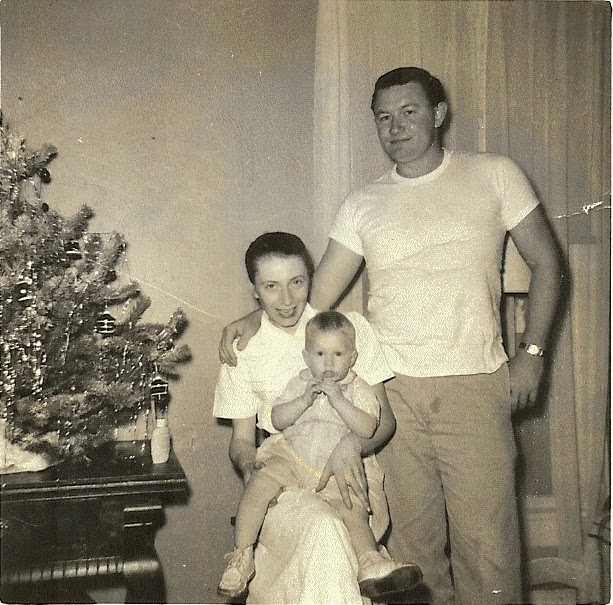
My 2nd Christmas, 1956. My first one was spent in an incubator. Note the festive bottle of talcum powder by the Christmas tree; a must-have for Festive Christmas-type decorations. My dad just looks relieved because he's on winter break from school. Unfortunately, there was no winter break from me.

He played everything from Debussy to Rachmaninoff, from Artie Shaw to Margaret Whiting, from Beethoven to Schumann. But his absolute favorite era was the Swing era, typically from the mid-30s to just after World War II. His absolute favorite group was the Glenn Miller (more about him later) Orchestra, with songs like “In the Mood” and “String of Pearls”, but for my money, the one song that is just so much fun and exemplifies so much excellent musicianship (for reasons I'll explain) is Benny Goodman's “Sing Sing Sing”.

courtesy:youtube.com

My folks used to jitterbug and I learned how to do it at an early age. It's rather improvisational, once you get the basic steps down, but it's a hell of a lot of fun. Think break-dancing while being vertical. Anyway, my dad and I would jitterbug to “Sing Sing Sing” and my mother would holler from the kitchen, “Don't break the furniture!” I'm pretty sure she thought we were rough-housing, but we were dancing.


There are several versions of this, but this is my favorite. 

The song was originally written by Louis Prima and has lyrics, but is most strongly identified with Benny Goodman, when he played it at the Palomar Ballroom in Los Angeles in 1936, during his second tour there. For the next several years, Goodman said, they were never able to play one-nighters without including this favorite.


Me, now, unscathed by any airplane encounters.

In analyzing the song itself, I note that the sudden crescendos and decrescendos in the horns and trombones are completely tight. The “bent” notes, so very typical in jazz and blues, are also precise, without seeming so. Goodman's playing is also remarkable because he, unlike many of the “Big Band” players had some classical training and later went on to commission pieces from Bartok, collaborate with Ingolf Dahl, an emigre composer at USC and director of the Victor Borge show and Goodman also recorded versions of Mozart's Clarinet Concerto. Clarinetists of the modern era will be forever grateful to Goodman for his work with composers Aaron Copland, Morton Gould and Malcolm Arnold, as well.


There's only one composer that I dislike intensely and have throughout my life; Mozart. With the exception of his "Mass in C minor" and "Don Giovanni" his music is like the same thing written 600 times over and it's a pain in the ass to play. Since I'm going to be 60 years old this year and have played violin and/or viola since age 11, I'm not going to be changing my mind about him anytime soon. Deal with it, Mozart lovers.


I know that in my musical life, when I first started out playing and listening, I fully expected to play predominantly classical music, but that's not the way it turned out. Although it is my first love, I did learn to play other styles; blues, jazz, hip-hop and even rock and roll. I've even play “Sing Sing Sing” with Bobby Vinton of all people. The great and wonderful thing about music is that you're not restricted to one genre, nor should you have to be. The only requirements needed are a willingness to learn and an open mind. Without those, we would not have the inventiveness and the brilliance that we should expect in all musicians; something I try to aspire to, but not always successfully. 

Wednesday, April 1, 2015

#A-TO-Z CHALLENGE 2015 – LETTER “A” - ALLEGRETTO (FROM BEETHOVEN'S SYMPHONY No. 7 IN A MAJOR)


Anybody who knows me, knows that Beethoven is going to be lurking around, in and through my posts and probably a lot during this challenge. My muse in all things, be it music or life, we do share an eerie number of characteristics, but have just as many differences. So, no; I am not channeling him, I just relate well to him and have a very similar temperament in what is acceptable and what is not, both in music, and in life.


Opening bars of the 2nd movement of Beethoven's Seventh Symphony

Having gotten that out of the way, let me just limn a brief description of what was going on in Beethoven's world, when his monumental Seventh Symphony was debuted, on December 8, 1813. During this period of time, parts of the Austro-Hungarian Empire (as it would later be called) were at war with Napoleon's forces and had been for several years. Vienna was tired, dispirited and her concert audiences were weary of being under his forces' occupation; the city had always possessed a sense of joie de vivre, second only to Paris, and in fact was probably a bit more fatalistic and understood that the party wouldn't last forever. Central and Eastern Europeans share that sense of fatalism with their Russian cousins and understand that in a way that Parisiéns have never been able to conceive. It gets darker the farther east you travel.


Anyway, Beethoven was one of the few people who worked on regardless of what was going on around him. After he had his temper tantrum in the funeral march of the “Eroica” Symphony, he went on to compose bigger and more complex symphonies, as he expanded upon his musical ideas. His pursuit and belief in the purity of his art is unparalleled and his relentless passion in that pursuit continued throughout his life, no matter what was going on around him. He was forever seeking an ideal, and although through his prose, it seems he may not have felt that he reached anything of the sort, anyone who listens to his music and is a true musician, understands what he was trying to reach, and in so many cases, achieved.


The very fact that Beethoven did much of his work under duress is not remarkable; many composers wrote and conceived brilliant music under some horrifying circumstances. One of these, Dmitry Shostakovich, was in Leningrad, during the siege of the city by the Nazis for 900 days. He was a volunteer fireman. Shostakovich managed to compose his Seventh, Eighth and Ninth Symphonies during and in between the shelling, starving and the typhoid outbreaks.

Beethoven's Viola - Bonn Haus, Germany

Beethoven also harbored another trait that is found in Shostakovich; a decency towards and belief in his fellow man. Ludwig could be one prickly cactus (he once called a town official a "donkey's ass", while Ludwig was in his cups), but inherently, down deep, he had a true belief that all men were equal and this is reflected in his music; never so much as in “Fidelio” and his Ninth Symphony, with the iconic “Ode to Joy”.

What does all of this blather have to do with the 2nd movement of his Seventh Symphony; the “Allegretto”? Well, now we're coming up on the more enigmatic part of this post. This particular “Allegretto” is often played as a stand-alone piece and for some reason seems to be subject to “added” features, as if the brilliant music of Beethoven's Allegretto were not enough.


Beethoven's Seventh Symphony2nd movement

Part of this is because there is no real “meaning” itself ever ascribed by Beethoven to this particular symphony, people have felt the need to make things up. Certainly, this is not the case of the “Eroica”, which was initially to have been a paean to Napoleon Bonaparte himself, but this idea was hastily abandoned and with rage, when Napoleon went on the warpath. Thus, the idea of the “Heroic” Symphony was born. The same can be said for the Sixth; the “Pastorale” Symphony, with it's suggestions of fauns prancing and playing pan-flutes, or some nonsense, until the thunder storm sends them scurrying.

This is Disney's idea of what the "Pastoral" Symphony should look like. Not sure that I'm on the same page with this nightmare, here.

No such theme or idea can be ascribed to the Seventh Symphony and in particular, the “Allegretto” has remained, er, fair game for any manner of interpretations and some rather ill-conceived and poorly-executed ideas.

courtesy:1zoom.net

If this picture is anything to go by, I'd have been ready to rest awhile and hear me some Beethoven's "Allegretto" from his Seventh Symphony.

The Seventh Symphony was debuted on December 8, 1813, to benefit the wounded soldiers of several months earlier, in the battle of Hanau. This was one of Beethoven's most successful concerts and Viennese audiences, sick with the malaise of siege, war and deprivation, embraced the symphony's energy and beauty. During the following months, the 2nd movement was played repeatedly, both as a stand-alone and as part of the rest of the Seventh Symphony. The Symphony itself enjoyed a popularity with the public that was unparalleled at the time, although there were critics – when are there not? One referred to the whole as “something sounding like badly-oiled syringes”. I'm guessing one would have to have heard that to make any comparison whatsoever.


I have never seen this movie, as much as I like Sean Connery. Something off-putting about a guy in a pigtail running around in his underpants throughout the entire thing, methinks.

But, the second movement itself, the “Allegretto” is STILL often played apart from the rest of the symphony and has graced everything from mediocre sci-fi movies, like “Zardoz”, with Sean Connery in his underwear, to horrible displays of interpretative dance choreographed by the ladies' Church Guild of my old home town, church, St. Paul's Catholic Church. It has been referred to as the “dance symphony”, but this does not give people license to dress up in filmy gowns, flit about the narthex and behave like wilting gladiolas – it's a buzzkill in my book. I guess it's like trying to gussy up a pig with lipstick, or throw glitter on a cat turd; it will not work, no matter the excellence of the diversion.

courtesy:zbhconline.org

The problem with interprative dance is the "interprative" part. Is this a crucifixion, or are the participants offering hosannas to that kid up there near the cross? Whatever it is, I'm pretty sure this is the part where I leave. God only knows what Beethoven would have made of the "wilting gladiolas" of his "Allegretto".

Even Beethoven himself abhorred critics and other composers and musicians trying to attach “meaning” or in today's parlance, a particular “label” to a piece of his music. I for one, feel that is how it should be. Purity of sound and structure on this level exists because it must and is there for the simple enjoyment of listening to. In a way, it is like having a wild and magnificent tiger come and sit by your side. You are graced by the presence of such music. I can find no other words to define how or what I really feel about the “Allegretto” movement of the Seventh Symphony of Beethoven. I just know beauty and the purity of the music and the spirit of it, when I hear it.