

It
was 1944, and swing music was making huge inroads in places in
America and overseas, following American troops as they made their
way into the various theaters of war. The U. S. O. was putting on
shows for the boys in the various branches of the Military, and one
of these boys, was serving on Okinawa, at the young age of seventeen,
having been given permission by his mother (his only living parent)
to join the Army, after having dropped out of high school the year
before, bored with the whole thing. He mustered out of San Francisco
and joined up with the forces on Okinawa, partially as occupation
forces and partly as escorts to the U. S. O. girls. Talk about
letting the fox into the hen house! The young man's name? Glenn Alton
Wallace, Junior. He would not only go on to not distinguish himself
in the Army, but he would later go on to join the Air Force and
become a pilot of B-29s in the Korean Action. The man loved to take
risks.

Lieutenant Glenn A. Wallace, Jr., Korea, 1952
He
also loved music and he loved Swing. In 1955, when he somehow became
ensnared by my mother's wiles and they married after his Air Force
stint, I came along – funny how that happens. My mother had decided
early on that she was NOT going to be married to a man of leisure,
nor one that had no education, although my father, for a high-school
drop out, was a smart man. He aced the college entrance exams and
went back to college on the GI bill and graduated from college within
three years; third in his class. I came along during his second year
of school. He brought me home from the hospital and was my primary
care-giver. He took me to class with him, took me to the bar – I
learned to walk in that bar at 9 months of age; the Wallaces being
precocious drunks – after class and I “did” homework with him.
Doing homework with him meant me shutting my trap for a few hours,
and the way to do this was to put SOMETHING on the 33 1/3
record-player.

Sheila Wallace, circa 1980. Yeah, my mom was a pilot, too. Me? I hate hate hate hate hate hate hate loathe flying. I'm not keen on balloons, either
In
all probability, and in hindsight, he most likely could have played
anything and I would have been happy. But, he played music he liked
and in turn, growing up with that kind of music, I learned to love
it. Thank God he and my mother were eclectic.
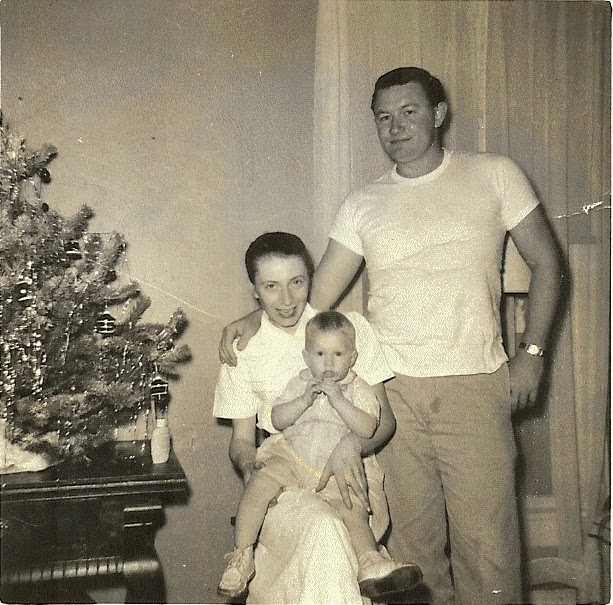
My 2nd Christmas, 1956. My first one was spent in an incubator. Note the festive bottle of talcum powder by the Christmas tree; a must-have for Festive Christmas-type decorations. My dad just looks relieved because he's on winter break from school. Unfortunately, there was no winter break from me.
He
played everything from Debussy to Rachmaninoff, from Artie Shaw to
Margaret Whiting, from Beethoven to Schumann. But his absolute
favorite era was the Swing era, typically from the mid-30s to just
after World War II. His absolute favorite group was the Glenn Miller
(more about him later) Orchestra, with songs like “In the Mood”
and “String of Pearls”, but for my money, the one song that is
just so much fun and exemplifies so much excellent musicianship (for
reasons I'll explain) is Benny Goodman's “Sing Sing Sing”.

courtesy:youtube.com
My
folks used to jitterbug and I learned how to do it at an early age.
It's rather improvisational, once you get the basic steps down, but
it's a hell of a lot of fun. Think break-dancing while being
vertical. Anyway, my dad and I would jitterbug to “Sing Sing Sing”
and my mother would holler from the kitchen, “Don't break the
furniture!” I'm pretty sure she thought we were rough-housing, but
we were dancing.
There are several versions of this, but this is my favorite.
The
song was originally written by Louis Prima and has lyrics, but is
most strongly identified with Benny Goodman, when he played it at the
Palomar Ballroom in Los Angeles in 1936, during his second tour
there. For the next several years, Goodman said, they were never able
to play one-nighters without including this favorite.

Me, now, unscathed by any airplane encounters.
In
analyzing the song itself, I note that the sudden crescendos and
decrescendos in the horns and trombones are completely tight. The
“bent” notes, so very typical in jazz and blues, are also
precise, without seeming so. Goodman's playing is also remarkable
because he, unlike many of the “Big Band” players had some
classical training and later went on to commission pieces from
Bartok, collaborate with Ingolf Dahl, an emigre composer at USC and
director of the Victor Borge show and Goodman also recorded versions
of Mozart's Clarinet Concerto. Clarinetists of the modern era will be
forever grateful to Goodman for his work with composers Aaron
Copland, Morton Gould and Malcolm Arnold, as well.

There's only one composer that I dislike intensely and have throughout my life; Mozart. With the exception of his "Mass in C minor" and "Don Giovanni" his music is like the same thing written 600 times over and it's a pain in the ass to play. Since I'm going to be 60 years old this year and have played violin and/or viola since age 11, I'm not going to be changing my mind about him anytime soon. Deal with it, Mozart lovers.
I
know that in my musical life, when I first started out playing and
listening, I fully expected to play predominantly classical music,
but that's not the way it turned out. Although it is my first love, I
did learn to play other styles; blues, jazz, hip-hop and even rock
and roll. I've even play “Sing Sing Sing” with Bobby Vinton of
all people. The great and wonderful thing about music is that you're
not restricted to one genre, nor should you have to be. The only
requirements needed are a willingness to learn and an open mind.
Without those, we would not have the inventiveness and the brilliance
that we should expect in all musicians; something I try to aspire to,
but not always successfully.

